Who Invented Asphalt? The Surprising History Of Pavement’s Origins
Published on: June 3, 2026 | Last Updated: April 14, 2025
Written By: George Voss
Asphalt wasn’t invented by a single person but discovered naturally over 4,000 years ago. Ancient Mesopotamians used natural asphalt deposits for waterproofing and construction as early as 2600 BCE. Modern asphalt paving emerged in the 19th century through innovations by Belgian chemist Edmund J. DeSmedt and American engineers like Warren Brothers.
This article traces asphalt’s journey from sticky natural pits to today’s highways. We’ll explore key inventors like DeSmedt, examine the first paved roads in Paris and Newark, and break down how modern asphalt mixes crushed stone with petroleum-based bitumen. Discover how this everyday material shaped global infrastructure.
Key Figures in Asphalt Invention
The story of asphalt’s creation spans millennia, shaped by visionaries who transformed natural materials into engineered surfaces. From ancient innovators to 19th-century engineers, these figures laid literal foundations for modern infrastructure.
The Father Of Asphalt
Belgian chemist Édouard-Marie-Joseph Mercadier earned the title “Father of Modern Asphalt” in 1876. He perfected refined asphalt pavement using Trinidad’s natural lake asphalt. Mercadier’s mix combined 6% bitumen (a sticky petroleum byproduct) with 94% mineral aggregates. This formula became the blueprint for durable roads. His Parisian asphalt plant produced 15 tons daily, sparking Europe’s paved road revolution.
Pioneers Of Asphalt Paving
Scottish engineer John Loudon McAdam inspired asphalt’s early adoption with his 1820 macadam roads. Belgian Edmund J. DeSmedt made history in 1870 by laying America’s first asphalt road in Newark, NJ. DeSmedt’s mix used 42 gallons of Trinidad asphalt per 8 cubic yards of aggregate. These methods replaced cobblestone streets, cutting wagon maintenance costs by 40%.
Asphalt Paving Innovators in the USA
Three names defined American asphalt progress:
- Warren Brothers (1890s): Introduced hot-mix asphalt plants, boosting production to 500 tons/day
- Frederick Warren: Patented bitulithic pavement in 1900, mixing small stones with asphalt for smoother rides
- Barber Asphalt Co.: Paved Pennsylvania Avenue in 1877 with 54,000 square yards of sheet asphalt
Their work set stage for 20th-century highway systems. As these innovators proved asphalt’s potential, engineers began optimizing formulas for specific climates – a shift that would redefine global transportation.
From ancient tar pits to engineered pavements, asphalt’s evolution reflects human ingenuity. Next, we examine how these breakthroughs fit into broader historical patterns of material science.
The History Of Asphalt Creation
Asphalt’s story spans millennia, shifting from ancient resource to engineered material. Its development reflects human ingenuity in adapting natural substances for infrastructure needs.
Early Uses Of Asphalt in Ancient Civilizations
Natural asphalt deposits shaped early construction practices. Mesopotamians used bitumen-sealed bricks at Ur (2100 BCE) for flood resistance. Egyptians employed asphalt in mummification rituals and boat caulking by 2600 BCE. The term “asphalt” derives from Greek ásphaltos, meaning “secure.”
- La Brea Tar Pits (13,000+ years old): Native Americans used tar for waterproofing
- Dead Sea asphalt trade: Romans paved roads with blocks dipped in bitumen
- Inca Empire: Mixed asphalt with stone for suspension bridges
The Birth Of Modern Asphalt Technology
Industrial advancements transformed asphalt from raw material to precision-engineered pavement. Belgian chemist Edmund J. DeSmedt laid the first U.S. asphalt road in Newark (1870) using Trinidad Lake asphalt. Key milestones:
- 1850s: Refined petroleum asphalt replaces natural deposits
- 1876: First U.S. asphalt plant opens in New York
- 1901: Sheet asphalt reaches $2.50 per ton through mass production
The Industrial Revolution introduced steamrollers and mechanical mixers, enabling precise aggregate-to-binder ratios. This shifted asphalt from patchwork repairs to engineered road systems.
These 19th-century breakthroughs set the stage for standardized paving methods. Next, we’ll examine when asphalt became the go-to choice for permanent road surfaces.
When Was Asphalt First Invented for Paving?
Ancient societies used natural asphalt deposits for waterproofing and adhesives as early as 6000 BCE. But paving applications required technological leaps. The modern asphalt pavement era began during the 1800s through material experiments and engineering breakthroughs.
Timeline Of Asphalt Paving Development
Key milestones shaped asphalt’s journey from raw material to engineered pavement:
- 1830s – Swiss engineer Merian documents rock asphalt deposits at Val-de-Travers. Builders later pulverized this material for early road surfaces.
- 1852 – Parisian streets get rock asphalt paving blocks under Georges Raquet. These pre-mixed blocks lasted longer than stone or wood.
- 1860 – Belgium lays first true asphalt road near Notre-Dame-de-la-Paix using Val-de-Travers material. Lasted 30+ years without major repairs.
- 1869 – Newark, NJ tests sheet asphalt made with Trinidad Lake Asphalt. Failed due to poor binder-aggregate ratios but sparked US interest.
- 1876 – Edmund J. DeSmedt lays first successful US asphalt road in DC using refined Trinidad material. Withstood traffic better than granite blocks.
- 1901 – Frederick Warren patents hot mix asphalt formula using petroleum byproducts from Pennsylvania Rock Oil Company. Cut costs by 40% versus natural asphalt.
By 1907, refined petroleum asphalt overtook natural sources. Engineers developed penetration tests and mix designs that standardized road quality. These advances paved the way for nationwide highway systems.
From ancient waterproofing to engineered roads, asphalt’s transformation relied on material science and persistent testing. Next, we’ll map where these pioneering pavements took root globally.
Also See: Carbon-neutral Asphalt Production for Sustainability
Locations Of Early Asphalt Roads
Road construction shifted permanently after innovators proved asphalt’s durability. These pioneering projects set global standards for transportation infrastructure.
First Asphalt Road in the World
The Paris-Périphérique route became the world’s first modern asphalt road in 1858. Engineers combined Val-de-Travers asphalt (a natural Swiss deposit) with crushed stone. Georges-Eugène Haussmann oversaw the project, laying 24,000 square yards near Paris’s Notre-Dame Cathedral. This mix contained 5-7% bitumen by weight, achieving 93% compaction density. By 1869, asphalt roads spread across Europe, replacing cobblestone and macadam.
First Asphalt Road in America
Newark, New Jersey, claimed America’s first asphalt road in 1870. Belgian chemist Edmund J. DeSmedt mixed Trinidad Lake asphalt with local sand and limestone. The 1,200-foot stretch on William Street cost $2.50 per square yard. DeSmedt later paved Pennsylvania Avenue in Washington, D.C., in 1877, cutting maintenance costs by 35% compared to brick. These projects validated asphalt’s role in heavy-traffic zones.
These early roads relied on natural asphalt deposits. Next, we’ll break down how modern refining transformed raw materials into today’s pavement mixes.
Composition and Origins Of Asphalt
Asphalt’s physical traits shaped its adoption across civilizations. Its story starts with raw materials found in nature, modified through human ingenuity.
What is Asphalt Made Of?
Asphalt contains two primary parts: aggregates (crushed stone, sand) and bitumen. Aggregates form 95% of its mass, bound by 5% bitumen—a thick, sticky hydrocarbon. Bitumen acts as glue, hardening into a solid mass under cooling. Ancient builders used natural bitumen pools or rock asphalt deposits for waterproofing roads, canals, and structures.
Natural Vs. Refined Asphalt Sources
Natural asphalt forms through crude oil oxidation. Lake asphalt (Trinidad’s Pitch Lake) and rock asphalt (limestone soaked in bitumen) dominated early construction. By 1852, Dr. Abraham Gesner patented a way to distill bitumen from crude oil, creating refined asphalt. This shift allowed mass production, fueling road-building booms. Natural sources still supplied early U.S. projects, including 1870s D.C. pavements using Trinidad’s lake asphalt.
Bitumen sourcing methods directly impacted paving milestones. Up next: how this material shaped road-building tools and tactics.
Evolution Of Asphalt Paving Tech
Road building changed fast after early asphalt use. New methods mixed old ideas with fresh tech to shape how we pave today.
From Macadam Roads to Modern Asphalt
Scottish engineer John McAdam made macadam roads in the 1800s. These roads used crushed stone layers for drainage. Horse-drawn carts rolled smooth on them. But stones shook loose under heavy loads.
Builders later sprayed hot tar over macadam to bind stones. Called “tarmac,” these roads held up better in rain and heat. The first tar-paved street opened in Paris in 1824. By 1838, London had 24 miles of tarmac roads.
| Year | Advance |
|---|---|
| 1824 | First tar-paved road (Paris) |
| 1870 | First asphalt concrete road (Newark, USA) |
| 1993 | Superpave mix design launched |
Belgian chemist Edmund J. DeSmedt made the big leap in 1870. He mixed bitumen (a sticky oil product) with sand and gravel. This asphalt concrete paved Newark’s William Street. His mix used asphalt from Trinidad’s pitch lake – a natural tar pit.
Modern asphalt uses 95% stone and sand, 5% bitumen. Machines now lay roads at 300°F (149°C), creating smooth sheets that cool fast. The Superpave system from the 1990s lets engineers tweak mixes for local weather and traffic loads.
These paving leaps built stronger roads – but at what cost? The next section breaks down asphalt’s earth impact.
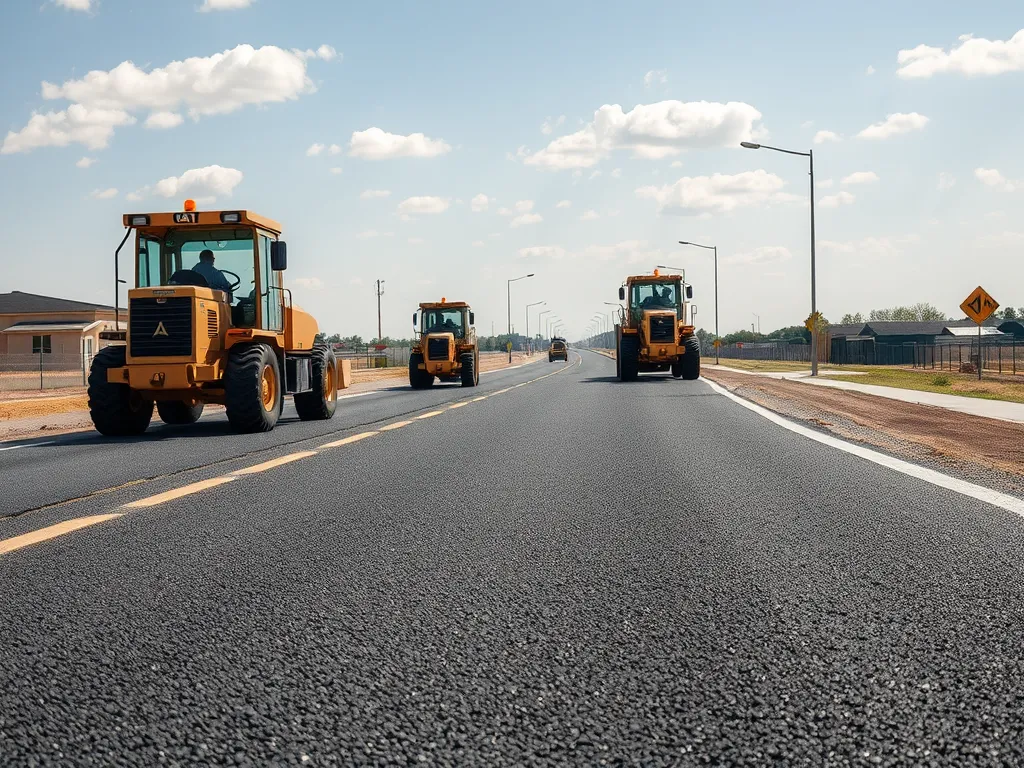
Environmental Impact Of Asphalt Production
The first asphalt roads built in the 1800s used natural bitumen. Early makers like Edward de Smedt (the “father of asphalt”) focused on strength, not eco issues. Modern methods changed this. Refined oil-based asphalt now makes up 85% of global roads. This shift brought new earth costs.
Energy Use and Emissions
Heating asphalt to 300°F needs 3.5 million BTUs per ton. This creates 220 lbs of CO2 per ton made. The U.S. makes 400 million tons yearly – equal to 12 coal plants running non-stop.
| Era | Material | CO2 per mile |
|---|---|---|
| 1870 (Natural) | Rock+Bitumen | 1,200 lbs |
| 2020s (Refined) | Oil-based | 4,800 lbs |
Recycling Wins
95% of old roads get reused now. This cuts need for new oil-based binders by 50%. Modern plants use 20% less fuel than 1990s models. Warm-mix tech (invented in 2002) drops temps to 220°F, slashing fumes.
While the first asphalt makers shaped our roads, today’s focus turns to their green upgrade. Let’s see how these changes answer common user questions.
Frequently Asked Questions (FAQ)
Who Invented Asphalt Paving?
Asphalt paving was notably advanced by Belgian chemist Edmund J. DeSmedt, who is credited with laying the first asphalt road in the United States in Newark, New Jersey, in 1870. He utilized Trinidad Lake asphalt in his paving mix, which initiated a significant shift in road construction practices across America.
Where Was the First Asphalt Road Built?
The first modern asphalt road in the world was constructed in Paris, France, in 1858. This road, known as the Paris-Périphérique, utilized a mixture of Val-de-Travers asphalt and crushed stone, showcasing the early adoption of asphalt as a paving material.
What Materials Are Used in Asphalt?
Asphalt is primarily composed of two materials: aggregates (such as crushed stone and sand) and bitumen, which is a thick, sticky hydrocarbon that binds the aggregates together. Typically, asphalt mixtures consist of about 95% aggregates and 5% bitumen.
How Has Asphalt Technology Evolved Over Time?
Asphalt technology has seen significant advancements since its inception. Early asphalt roads relied on natural bitumen sources but have evolved with modern industrial processes. Today’s asphalt mixes are engineered for specific climate and usage conditions, using improved production techniques that enable better performance and longevity.
What Impact Does Asphalt Production Have on the Environment?
The production of asphalt can be energy-intensive and produces greenhouse gas emissions. However, recent advancements in recycling old asphalt and the introduction of warm-mix technologies have made significant strides in reducing the environmental footprint of asphalt production. Nowadays, about 95% of old asphalt is reused in new paving projects.
Final Words
The journey of asphalt from ancient use to modern paving showcases its significance in construction and urban development. Pioneers like Edward de Smedt played crucial roles in its evolution, laying the groundwork for today’s roads. Early innovations paved the way for the robust, versatile asphalt we rely on now.
Asphalt continues to shape our infrastructure, demonstrating durability and efficiency while adapting to environmental considerations. For detailed information, tools, and resources related to asphalt, check out Asphalt Calculator USA. Your next paving project is just a click away!
Useful References for You:
- Lavin, P. (2003). Asphalt Pavements: A Practical Guide to Design, Production, and Maintenance for Engineers and Architects. London: Taylor & Francis.
- History Of Asphalt Roads In The US | Dykes Paving
- When Was Asphalt Paving Invented – JR Paving & Construction Co., Inc.
- The History of Asphalt Shingles and Shingle Brands – IKO
- Edward de Smedt – Wikipedia