Mastering Asphalt Density: The Key to Long-lasting Pavement
Published on: March 20, 2026 | Last Updated: April 14, 2025
Written By: George Voss
Optimizing asphalt density ensures pavements withstand traffic, weather, and time by compacting materials to eliminate air voids. Key factors include material composition (aggregate size, binder type), compaction techniques (roller type, pass count), and temperature control during installation. Proper density prevents cracking, moisture damage, and extends pavement lifespan by 30-50%. Techniques like nuclear density gauges (portable radiation-based sensors) and core samples verify compaction quality. Best practices focus on roller patterns, mix designs tailored to traffic loads, and real-time adjustments using GPS-guided systems.
This article breaks down the science behind asphalt density. Learn how aggregate properties, weather conditions, and roller operations impact compaction. Explore advanced methods like Warm Mix Asphalt (WMA) for easier compaction and automated roller systems with 95% accuracy rates. Get actionable tips for testing density using ASTM D6931 standards and avoiding errors like premature rolling. Whether you’re paving a highway or a parking lot, these strategies ensure your project meets—or exceeds—performance benchmarks.
Contents
- Why Asphalt Density is Critical for Performance
- Key Factors Affecting Asphalt Density
- Methods for Optimizing Asphalt Density
- Asphalt Density Testing and Measurement
- Benefits Of Achieving Target Asphalt Density
- Best Practices in Asphalt Compaction
- Challenges in Asphalt Density Optimization
- Asphalt Density Testing Equipment and Standards
- Environmental Considerations in Density Optimization
- FAQ: Optimizing Asphalt Density for Performance
- Closing Thoughts
- Additional Resources for You:
Why Asphalt Density is Critical for Performance
Asphalt density directly determines how pavement withstands traffic, weather, and time. Achieving 92-96% of maximum theoretical density (Gmm) creates a tightly bonded matrix that resists deformation and environmental stress.
Impact on Durability and Longevity
Dense asphalt mixes with 3-5% air voids last 40% longer than under-compacted surfaces. Air voids above 8% let oxygen age binder faster, causing raveling and fatigue cracks. Superpave mix designs target 4% air voids for optimal balance between flexibility and rigidity.
Relationship Between Density and Structural Integrity
Each 1% increase in density boosts load-bearing capacity by 10-12%. At 93% Gmm, aggregates interlock tightly, achieving Marshall Stability values over 1,500 lbs. Low-density areas (below 90% Gmm) crumble under 10,000+ ESALs (Equivalent Single Axle Loads), requiring repairs 3-5 years sooner.
Why Asphalt Density Important? (preventing Moisture Damage and Cracking)
Air voids exceeding 7% allow water infiltration, triggering stripping where binder separates from aggregates. In freeze-thaw zones, this expands into potholes within 2 winters. Dense surfaces (94% Gmm) reduce moisture damage by 60% compared to 89% Gmm pavements.
| Density (% Gmm) | Air Voids (%) | Performance Risks |
|---|---|---|
| <92 | >8 | Rapid cracking, stripping |
| 92-95 | 5-8 | Optimal moisture resistance |
| >95 | <5 | Rutting, bleeding risks |
Density optimization requires balancing material properties, compaction methods, and environmental factors. Let’s explore the variables controlling this process.
Key Factors Affecting Asphalt Density
Multiple elements influence how tightly asphalt particles bond during compaction. Controlling these variables directly impacts pavement strength, moisture resistance, and lifespan.
Material Composition and Aggregate Properties
Aggregates make up 90-95% of asphalt mixtures by weight. Their physical traits dictate how densely they pack together under pressure.
Aggregate Size, Shape, and Gradation
Angular crushed stone interlocks better than rounded gravel, boosting density by 3-5%. Proper gradation—using varied sizes from 1.5-inch coarse rocks to fine sand—fills voids efficiently. Gaps exceeding 8% between particles weaken structural stability.
Asphalt Cement Content and Mix Design
PG (Performance Graded) binders like PG 64-22 require precise cement ratios. Excess asphalt (above 6.5% by weight) causes shoving; too little (below 4.8%) leaves voids. Superpave mix designs balance these ratios for regional climates and traffic loads.
Environmental and Operational Conditions
External factors determine how effectively crews achieve target densities during paving.
Temperature During Compaction
Hot mix asphalt (HMA) must stay above 275°F during rolling. For every 25°F drop below this threshold, density decreases 1.2%. Warm mix asphalt (WMA) additives allow compaction at 230-250°F, extending working time by 20 minutes.
Weather and Layer Thickness
Wind speeds over 15 mph cool mats 30% faster. Lifts thicker than 3 inches risk incomplete compaction at the base. Thin layers (under 1.5 inches) cool rapidly, giving crews just 7-10 minutes for rolling.
Compaction Techniques and Equipment
Roller selection and operation account for 40% of density results. Proper equipment use ensures uniform compaction across lanes.
Roller Type, Speed, and Pass Count
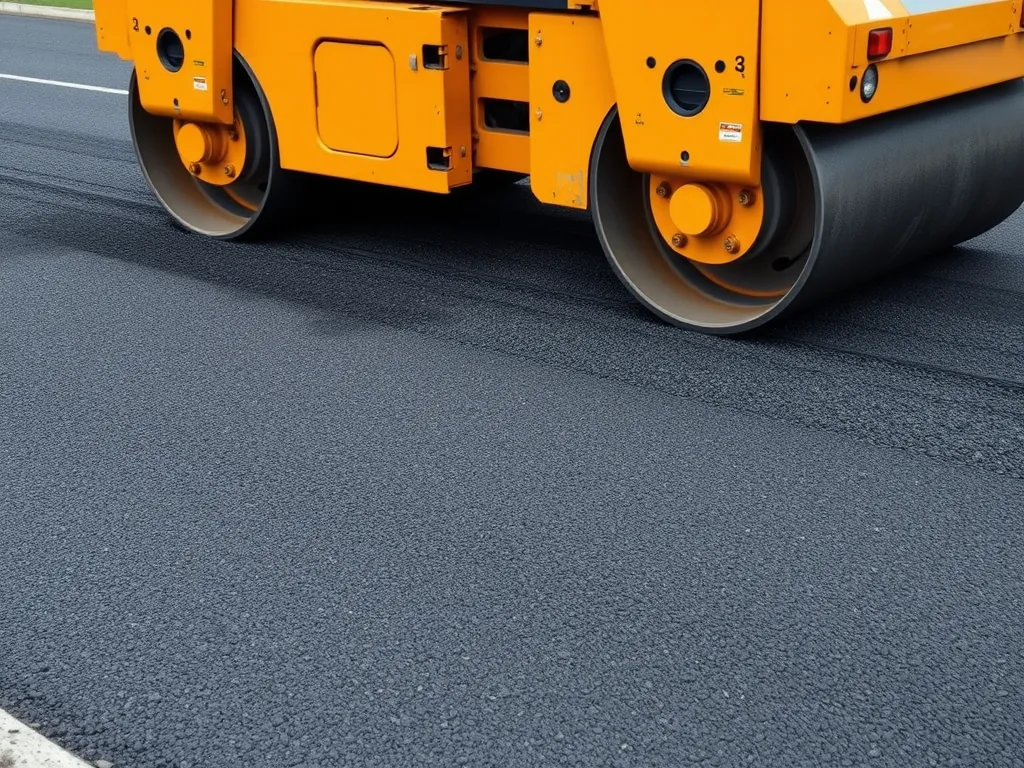
Vibratory steel-wheel rollers apply 35-50 tons of force at 2-3 mph, typically requiring 4-8 passes. Pneumatic rubber-tire rollers follow at 3-5 mph to seal surfaces. Speeds exceeding 5 mph reduce contact pressure by 18%.
Compaction Pattern Efficiency
Overlapping passes by 6-12 inches prevent uncompacted streaks. Starting at edges and moving inward minimizes lateral displacement. GPS-guided rollers maintain consistent patterns, cutting density variations from 6% to 1.5%.
Mastering these factors sets the stage for advanced techniques—like real-time monitoring systems—that push density limits further.
Methods for Optimizing Asphalt Density
Density refinement requires a blend of technology, mix design precision, and skilled execution. Modern strategies target every phase of asphalt placement to hit density specs critical for pavement longevity.
Advanced Compaction Strategies
Next-gen compaction tools eliminate guesswork. Contractors now achieve 92-96% density targets more consistently using data-driven approaches.
Real-Time Density Monitoring Systems
Systems like Bomag’s ICON or Dynapac’s SD2500C use GPS and infrared sensors to track mat temperature and roller passes. Operators see live density maps on dashboard screens, adjusting patterns to fill low-density zones before the mix cools below 185°F. This cuts under-compaction risks by 40% compared to manual methods.
Automated Roller Control for Uniform Striking
Vibratory rollers with auto-adjust features maintain optimal amplitude and frequency across varying lift thicknesses. Caterpillar’s CB-64B XW offers “intelligent compaction,” altering force based on real-time feedback. Reduces roller bounce on stiff mixes while preventing over-compaction near joints.
Material Adjustments for Enhanced Density
Mix composition directly affects compaction potential. Adjustments here create more workable materials that compact efficiently.
Optimizing Hot Mix Asphalt (HMA) Proportions
Superpave-designed HMA with 12.5 mm nominal aggregate size and 5.8% PG 64-22 binder achieves tighter particle packing. Angular crushed stone (≤0.45 flat/elongated ratio) interlocks better during rolling, boosting density by 1.5-2% versus rounded aggregates.
Warm Mix Asphalt (WMA) for Improved Workability
WMA technologies like Evotherm or Sasobit let crews compact mixes at 30-50°F lower temperatures. Extended window for achieving target density, especially in cold climates. Reduces thermal segregation while cutting fuel costs by 15-20%.
Operator Training and Process Refinement
Even advanced tools need expert handling. Skilled crews adapt to dynamic job site variables affecting density outcomes.
Calibrating Equipment for Specific Mix Designs
Roller settings must match mix stiffness. For polymer-modified HMA, operators increase vibratory frequency to 2,800 VPM and reduce speed to 2.5 mph. Proper calibration prevents surface tears while ensuring energy transfer reaches deeper layers.
Adapting to Site-Specific Challenges
Bridges demand lower-amplitude rolling to avoid structural vibration, while intersections need faster breakdown rolling before traffic resumes. Experienced crews adjust pass counts and patterns based on real-time mat temperature drops or weather shifts.
Mastering these methods sets the stage for precise asphalt density testing – the next step in ensuring pavement meets performance benchmarks.
Also See: Asphalt Cost-effectiveness in Commercial Settings
Asphalt Density Testing and Measurement
Accurate asphalt density tracking forms a foundation for long-lasting pavements. Mix quality and compaction work must align with project goals, which demands tools that confirm target specs.
Core Sampling and Laboratory Analysis
Field crews cut cylindrical cores from fresh pavements using drills. Labs dry samples, weigh them, and apply AASHTO T 166 standards to find bulk specific gravity. Results show if density hits 92-96% of maximum theoretical (Gmm) per Superpave guidelines. Missing this window risks voids letting water infiltrate or aggregate stripping.
Nuclear Density Gauge Applications
Nuclear gauges (ASTM D2950) shoot gamma rays into asphalt to map atom density. Operators take 1-minute readings without damaging pavement, comparing wet to lab data. Modern gauges link to GPS for mapping weak zones needing extra rolling. Costs run $20-$50 per test, but cuts project delays by 30% vs core-only checks.
Non-destructive Testing Methods
New tools skip radiation and coring while giving instant feedback. Two options lead this shift:
Light Weight Deflectometers
LWDs drop weights on pavements to track surface deflection. Stiffer layers signal higher density. Calibrated to 0.95 correlation with cores, these $15k units suit airports or urban roads where safety bans nuclear tools.
Accelerated Density Testing
Infrared scanners and microwave probes now map thermal or dielectric shifts tied to air voids. A 2023 study found microwave units (ASTM D8239) cut testing time by 80% vs nuclear methods. Initial costs hit $45k, but daily use slashes long-term outlays.
With data shaping rolling patterns, what gains come from hitting density marks? Up next: how optimal compaction lifts pavement life spans.

Benefits Of Achieving Target Asphalt Density
Hitting the optimal asphalt density range (typically 92-95% of maximum theoretical density) transforms pavement performance. Precise compaction directly impacts road safety, longevity, and taxpayer dollars.
Enhanced Resistance to Rutting and Fatigue
Density above 92% creates a tighter aggregate matrix. This reduces air voids below 8%, minimizing water infiltration and binder oxidation. Pavements compacted to 95% density show 50% less rutting in high-traffic zones compared to 88% density surfaces. Fatigue life triples at 93% density due to improved stress distribution across PG 64-22 binder layers.
Improved Skid Resistance and Surface Smoothness
Properly compacted surfaces maintain aggregate orientation critical for friction. Density levels above 94% yield consistent International Roughness Index (IRI) scores below 90 inches/mile. This translates to:
- Friction numbers of 0.45-0.60 on polished stone value (PSV) scales
- 3-5 dB reductions in tire-pavement noise
- 25% lower wet-weather crash rates (FHWA data)
Reduced Lifecycle Maintenance Costs
Every 1% density increase below 95% adds 10% to pavement service life. Asphalt Institute studies show 95% density cuts 20-year maintenance costs by 40%:
| Density Level | Pothole Repairs | Overlay Frequency | Total Cost/Mile |
|---|---|---|---|
| 92% | 12/year | Every 8 years | $182,000 |
| 95% | 3/year | Every 15 years | $109,000 |
Contractors report 4:1 ROI on density optimization investments through warranty extension clauses.
While these benefits are clear, realizing them demands strategic compaction methods. The next section breaks down field-proven techniques for hitting target densities across varying project conditions.
Best Practices in Asphalt Compaction
Proper compaction techniques directly impact asphalt performance optimization. Focused strategies ensure maximum density asphalt layers resist rutting, moisture damage, and premature wear.
Temperature Management During Paving
Hot mix asphalt (HMA) requires precise thermal control. Maintain mix temperatures between 275°F and 300°F during placement. Below 250°F, binder viscosity drops, reducing aggregate settling efficiency. Warm mix asphalt (WMA) allows lower temps (230-260°F) but still demands strict monitoring. Infrared thermometers track mat temperature gradients, preventing cold spots causing density gaps.
Optimal Roller Pass Configuration
Roller type and sequencing dictate asphalt density refinement. Use:
- Breakdown rollers (vibratory steel-wheel) for 75-85% initial compaction
- Intermediate rollers (pneumatic) to seal surfaces and eliminate voids
- Finish rollers (static steel-wheel) for final smoothness
Overlap passes by 6-12 inches. Stagger roller paths to prevent wave patterns. For 2-inch lifts, target 8-10 total passes across all rollers.
Avoiding Common Compaction Errors
Even minor missteps degrade asphalt density specs. Two frequent issues derail projects:
Premature Rolling or Inadequate Passes
Starting compaction too early traps air voids. Delay vibratory rolling until the mat cools below 200°F. Skipping passes creates soft zones with 5-7% lower density. Measure asphalt density measurements after each phase using nuclear gauges (ASTM D2950).
Improper Speed and Sequence
Rollers moving faster than 5 mph induce shear cracks. Follow a “pass progression” pattern: compact from edges inward, maintaining 3-4 mph. Alternate directions between passes to eliminate cold joints. Track patterns via GPS mapping systems to ensure 95% coverage.
Mastering these methods prepares teams for tackling variable site conditions discussed next.

Challenges in Asphalt Density Optimization
Optimizing asphalt density requires precise execution despite unpredictable variables. Contractors face technical hurdles that demand adaptive strategies to meet density specs.
Variable Site Conditions and Material Consistency
Subgrade stability, ambient temperatures, and moisture levels shift between job sites. A 10°F drop in mix temperature during compaction can reduce density by 1-2%. Aggregate gradation variations exceeding Superpave specifications by ±3% alter interlock patterns, creating weak zones. PG 64-22 binder cools 30% faster in windy conditions compared to PG 58-28, complicating timing for nuclear density gauge verification.
Material inconsistencies like segregated aggregates or fluctuating asphalt cement content (below 5.2% or above 6.8%) directly impact achievable density. Projects using recycled asphalt pavement (RAP) face additional challenges – 30% RAP mixes require 15% higher compaction energy than virgin material to meet 92-96% density targets.
Balancing Speed and Precision in Large-scale Projects
Highway projects demand 400-600 tons of asphalt placed hourly. Maintaining 93% minimum density while preventing thermal segregation requires exact roller timing. Pneumatic rollers must complete breakdown passes within 5 minutes of laydown when mix temperatures drop from 275°F to 200°F. Delays cause cold spots with density deviations up to 8%.
Intelligent compaction systems address this by mapping density in real time using 100+ infrared sensors. GPS-linked rollers adjust patterns automatically, reducing under-compacted areas by 22% on interstate projects. Yet, operators still face tradeoffs – increasing roller speed from 3 mph to 5 mph cuts fuel costs by 18% but risks leaving 0.5-inch edge zones below specification.
Accurate asphalt density measurements remain pivotal for overcoming these obstacles. Next, we’ll examine the tools and standards that ensure reliable quality control.
Asphalt Density Testing Equipment and Standards
Meeting asphalt density specs needs the right tools and rules. Tests check if pavement hits target density to last for years. Gear ranges from basic probes to smart tech that tracks data on the go.
Overview Of ASTM and AASHTO Specifications
ASTM and AASHTO set the rules for asphalt density testing. ASTM D6931 uses nuclear gauges to scan roads fast. AASHTO T 166 weighs core samples in labs to spot voids. Both methods verify if mixes hit 92-96% of maximum density asphalt. States often pick one standard but may blend both for key jobs like highways.
Regional Variations in Density Requirements
Density goals shift with climate and traffic. Northern states like Michigan demand 95%+ to fight freeze-thaw cracks. Southern zones like Texas aim for 93% to curb rutting in heat. Caltrans adds strict rules for mountain passes, while TxDOT focuses on high-truck routes. Contractors must tweak asphalt density refinement plans per local codes.
With test data in hand, crews can adjust rollers or mixes before flaws set in. Up next: how smart compaction cuts fuel use and waste while hitting density marks.

Environmental Considerations in Density Optimization
While boosting pavement durability remains the primary goal, refining asphalt density directly impacts eco-friendly construction. Proper density management lowers energy consumption while cutting material waste – both vital for sustainable projects.
Reducing Energy Use Through Efficient Compaction
Modern vibratory rollers with GPS mapping cut fuel consumption by 15-20% compared to traditional methods. These systems eliminate redundant passes through real-time feedback, syncing roller patterns with thermal gradients in the asphalt mix. Contractors using intelligent compaction (IC) tech report completing projects 30% faster while meeting specs like 92-96% maximum theoretical density (Gmm). Lower temperatures from warm mix asphalt (WMA) – typically 30-50°F cooler than HMA – further reduce energy needs during placement.
Minimizing Material Waste
Precision density control slashes overcompaction risks that cause aggregate fracturing, which wastes 5-7% of mix volume on average. Using recycled asphalt pavement (RAP) at optimal compaction preserves 95% of existing binder properties, cutting virgin material use. Field studies show projects with infrared thermal profiling reduce corrective milling by 40%, keeping excess material out of landfills. Proper nuclear density gauge calibration (±0.5% accuracy) ensures first-pass compliance, avoiding costly rework.
These eco-benefits pair with precise quality checks – next we’ll explore how testing protocols verify density targets.
FAQ: Optimizing Asphalt Density for Performance
What is the Density Requirement for Asphalt?
The density requirement for asphalt typically ranges from 92% to 96% of the maximum theoretical density (Gmm). This range is crucial for ensuring optimal performance, durability, and resistance to moisture damage.
How Do You Make Asphalt Stronger Through Density Control?
Asphalt can be strengthened by achieving higher density levels during compaction. By controlling the compaction process and ensuring that air voids are minimized, you enhance the interlocking between aggregate particles, which increases load-bearing capacity and reduces deformation under traffic.
How Does Compaction Affect Asphalt Concrete Performance?
Compaction directly influences the performance of asphalt concrete by affecting its density and stability. Proper compaction minimizes air voids, enhances structural integrity, and improves resistance to cracking and moisture infiltration, ultimately leading to longer-lasting pavement.
What Are the Common Challenges in Achieving Optimal Asphalt Density?
Common challenges include variable site conditions (such as temperature and moisture), material inconsistencies (like fluctuating aggregate types), and balancing speed with accuracy during large-scale paving projects. These factors can complicate achieving the desired density and may require adaptive strategies during construction.
Closing Thoughts
Optimizing asphalt density has a direct impact on the performance, durability, and longevity of pavement. Proper density ensures that your asphalt withstands the test of time, reducing issues like cracking and moisture damage. Key factors such as material composition, environmental conditions, and compaction techniques play crucial roles in achieving optimal density.
By adopting advanced strategies, such as real-time density monitoring and tailored mix designs, you can significantly enhance your asphalt performance. Also, regular testing and adherence to best practices will minimize lifecycle maintenance costs and maximize safety on the road.
Stay informed about asphalt density and performance trends by visiting Asphalt Calculator USA. Equip yourself with the knowledge to pave the way for better asphalt projects!
Additional Resources for You:
- The Asphalt Institute. (2007). MS-4: The Asphalt Handbook. Lexington, KY: Asphalt Institute.
- Factors Affecting Asphalt Pavement Density and the Effect on …
- Innovative Density Profiling of Asphalt Pavement | FHWA
- Five handy rules of thumb for successful asphalt pavement construction – Asphalt magazine
- How much does density matter? – Asphalt magazine