
Interpretation Of Marshall Test Results for Asphalt Mix Design
Published on: March 4, 2026 | Last Updated: April 14, 2025
Written By: George Voss
The interpretation of Marshall test results is the process of analyzing lab data to evaluate asphalt mix performance. Engineers measure stability (load resistance), flow (deformation under stress), density, air voids, VMA (voids between aggregates), and VFA (binder-filled voids). These values determine if the mix can handle traffic loads while resisting cracks, rutting, or moisture damage.
This article explains how to read Marshall test reports like a pro. You’ll learn to assess stability-flow balance, calculate ideal asphalt content, and avoid common errors. We cover sample prep methods, ASTM D6927 standards, and how precise testing reduces material waste by up to 15% in pavement projects.
Contents
- Overview Of the Marshall Test in Asphalt Engineering
- Preparing Asphalt Samples for Marshall Testing
- Key Parameters in Marshall Test Results Analysis
- Step-by-step Interpretation Process
- Practical Applications in Asphalt Mix Design
- Common Mistakes in Marshall Test Interpretation
- Environmental Considerations
- FAQs: Interpretation Of Marshall Test Results
- Closing Thoughts
- Additional Resources for You:
Overview Of the Marshall Test in Asphalt Engineering
The Marshall test remains the backbone of asphalt mix design since its 1940s development by Bruce G. Marshall. This empirical method evaluates hot mix asphalt (HMA) performance under traffic loads through controlled laboratory conditions. Interpretation of Marshall test results directly impacts pavement durability, rut resistance, and structural integrity.
Purpose and Core Components
Engineers use Marshall test analysis to optimize two critical factors: asphalt binder content and aggregate structure. The test measures three primary parameters – stability (load resistance), flow (deformation capacity), and density (compaction quality). These metrics determine whether a mix meets ASTM D6927 specifications for specific traffic loads.
Measuring Stability, Flow, and Density
Stability values (8-16 kN for most roads) reflect a mix’s maximum load-bearing capacity before failure. Flow values (2-4 mm) indicate flexibility – too low causes brittleness, too high risks rutting. Density percentages (96-98% theoretical maximum) show compaction effectiveness. Proper Marshall test results interpretation balances these interdependent factors.
Standard Test Procedure
The process involves heating aggregates and binder to 150-165°C, compacting specimens with 50-75 blows per side, then curing at 60°C. A Marshall testing machine applies 50mm/minute loading until failure. Technicians record peak load (stability) and deformation at failure (flow) while calculating air voids and density.
Role of Compaction (Number of Blows)
Compaction energy directly impacts test outcomes. Heavy traffic roads require 75 blows/side versus 50 for local roads. Each additional blow increases density by 0.5-1.2%, affecting stability (up 15%) and flow (down 8%). Misapplied compaction leads to false positives in Marshall test analysis – a common error in mix design validation.
With proper sample preparation established, the next phase examines how aggregate gradation and binder selection influence these critical test metrics.
Preparing Asphalt Samples for Marshall Testing
Proper sample prep sets the stage for reliable Marshall test results. Errors here can skew data on stability, flow, and voids.
Aggregate Gradation and Binder Selection
Aggregate size mix shapes how asphalt bears weight. Use sieve tests to hit target gradation:
- #4 sieve (4.75mm) for coarse stone
- #200 sieve (0.075mm) for fine sand/filler
Pair with PG binders (like PG 64-22) that match local temps. Too much binder? Low stability. Too little? High air voids.
Compaction Methods for Asphalt Specimens
Marshall hammers pack hot mix into test molds. Hit these specs:
- 50 blows per side for light traffic
- 75 blows per side for heavy loads
Wrong blow counts create false air voids. This leads to flawed Marshall test analysis for density or strength.
Controlling Temperature During Preparation
Keep mix at 150-160°F during prep. Why?
- Cold mix = poor compaction = high voids
- Hot mix = binder runoff = low stability
Track temps with infrared guns. Even a 15°F drop changes flow values by up to 8%.
With samples prepped right, you’re set to crack the code of Marshall test results. Next, we’ll break down what each data point means for real roads.
Key Parameters in Marshall Test Results Analysis
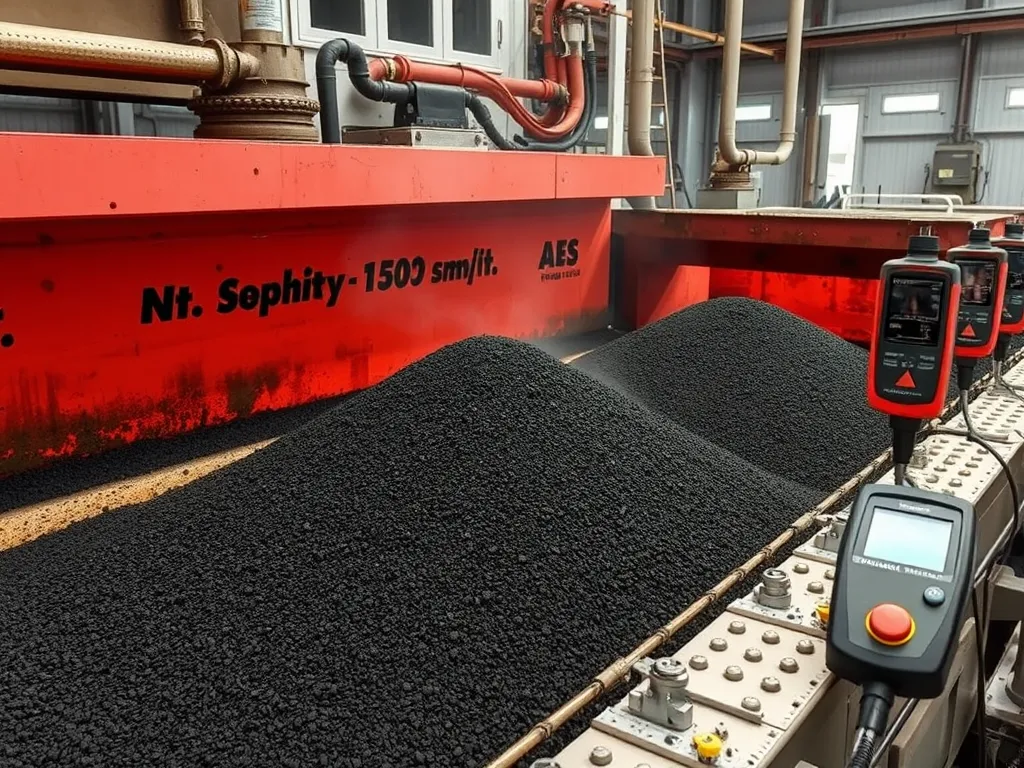
To grasp Marshall test interpretation fully, focus on five vital factors. Stability, flow, air voids, VMA, and VFA form a matrix that predicts how asphalt will act under traffic and weather.
Marshall Stability Value
Stability quantifies a mix’s maximum load capacity in pounds (lbs) before failing. Highways typically aim for 1,200-1,800 lbs, while parking lots may drop to 750-1,200 lbs. Values below thresholds signal weak bonding or poor compaction.
Significance in Load-Bearing Capacity
Stability directly links to rutting resistance. A 1,500-lbs mix can handle 10,000 daily trucks better than a 900-lbs mix. PG 64-22 binders often boost stability by 15% vs PG 58-28 in warm zones.
Flow Value Interpretation
Flow tracks vertical deformation (0.01-inch units) during stability testing. Ideal ranges sit at 8-16 units. Low flow (<6) hints at brittleness; high flow (>20) flags potential rutting.
Relationship to Flexibility and Rutting Resistance
Flow and stability must balance. A 1,400-lbs stability with 12 flow units allows slight bending without cracking. Mixes hitting 1,800 lbs but 4 flow units may shatter in cold snaps.
Air Voids Analysis
Air voids (3-5% target) act as a mix’s shock absorbers. At 2%, asphalt bleeds in heat; at 8%, water infiltrates, cutting pavement lifespan by 30-50% through stripping.
Impact on Durability and Moisture Damage
Voids above 5% let water attack binder-aggregate bonds. Florida DOT data shows 1% void growth can trigger 25% faster raveling in coastal roads. Anti-stripping agents like lime cut this risk by half.
VMA (Voids in Mineral Aggregate)
VMA measures space between aggregates pre-binder addition. 14-16% is typical for surface layers. Below 13%, mixes lack enough binder film; above 18%, rutting risks climb sharply.
VFA (Voids Filled With Asphalt)
VFA shows how much binder fills VMA spaces. Optimal 65-75% VFA stops aging (low VFA) or rutting (high VFA). A 68% VFA mix lasts 2-3 years longer than 62% VFA in freeze-thaw zones.
With these factors mapped, asphalt teams can tackle stability-flow balancing and pinpoint optimal binder ratios – key steps in our next section.
Also See: Industrial Revolution Effects on Asphalt Production
Step-by-step Interpretation Process
Interpreting Marshall test results requires methodical evaluation of five key parameters: stability, flow, air voids, VMA, and VFA. Engineers use this data to verify mix durability, flexibility, and resistance to deformation.
Evaluating Stability-flow Balance
Stability (measured in kN) indicates load-bearing strength, while flow (0.1-inch units) shows flexibility. Ideal mixes balance these values – high stability with moderate flow (8-16 range). Ratios below 500 kN per 0.1 inch risk rutting; ratios above 750 cause brittle cracking. For example, 12 kN stability with 14 flow = 857 ratio signals potential thermal cracking.
Optimum Asphalt Content Determination
Plot stability, density, and air voids against binder content to find the optimum asphalt content (OAC). Peak stability and maximum density typically align at 4-6% binder content. OAC must also place air voids within 3-5% and VFA between 65-78%. A 5.2% OAC hitting 4.1% air voids and 70% VFA meets most specs.
Acceptance Criteria for Asphalt Mixes
Test results are compared against project-specific or agency standards. Florida DOT requires ≥12 kN stability for highways, while Minnesota allows 8 kN for local roads.
Industry Standards and Thresholds
AASHTO T 245 mandates stability ≥8 kN, flow 8-16, and 3-5% air voids. ASTM D6927 adds VMA thresholds (13% min for NMAS 19mm). Warm-mix asphalt often uses modified criteria – 6 kN stability with 2-4% air voids in recycled mixes.
Accurate Marshall test analysis directly impacts pavement lifespan. Next, we’ll explore how these interpreted results translate to real-world mix designs and performance predictions.

Practical Applications in Asphalt Mix Design
Marshall test results interpretation drives critical decisions in asphalt engineering. Engineers use these insights to refine mixes, forecast pavement behavior, and maintain production quality.
Optimizing Aggregate-binder Ratios
Marshall test analysis reveals how aggregates and bitumen interact. Stability values above 12 kN (kilonewtons) paired with flow values of 8-16 units (0.1-inch increments) signal optimal ratios. Too much binder lowers stability, causing rutting. Insufficient binder raises air voids above 5%, inviting moisture damage. Adjusting ratios using VMA (Voids in Mineral Aggregate, ideally 14-18%) and VFA (Voids Filled with Asphalt, 65-75%) ensures balanced performance.
Predicting Pavement Performance
Interpreting Marshall test scores forecasts how mixes handle real-world stress. High-traffic highways need stability values exceeding 15 kN to resist deformation. Flow values below 8 units indicate brittle mixes prone to cracking. Air voids between 3-4% balance durability and flexibility. For example, a mix with 4.2% air voids and 13 kN stability may fail in freeze-thaw cycles due to water infiltration.
Quality Control for Production Mixes
Marshall test results interpretation validates consistency in plant-produced batches. Field samples are tested against lab-designed targets. A 10% drop in stability (e.g., from 14 kN to 12.6 kN) flags aggregate gradation errors or binder inconsistencies. Tight air void tolerances (±0.5%) prevent premature aging. Daily tests ensure mixes meet AASHTO T 245 or ASTM D6927 standards.
Even precise Marshall test analysis can falter without addressing common errors in sample handling and data evaluation. Let’s examine frequent pitfalls next.
Common Mistakes in Marshall Test Interpretation
Even skilled engineers face pitfalls when interpreting Marshall test results. Three frequent errors distort mix design decisions, leading to pavement failures or inflated costs. Let’s break down these issues.
Ignoring Temperature Effects on Results
Bitumen viscosity changes with temperature, directly impacting stability and flow values. Testing samples cooled below 140°F (60°C) may show 20% higher stability readings than those tested at 212°F (100°C). For precise Marshall test analysis, maintain specimen temperatures within ASTM D6927’s 275±5°F range during compaction. Post-compaction, cure samples at 77°F for 30 minutes before testing.
Improper Sample Compaction Techniques
Compaction energy (blow count) directly shapes density and air void levels. Using 50 blows for heavy-traffic mixes (designed for 75 blows) creates false density readings. This error pushes engineers to reduce binder content, increasing voids and cracking risks. Mechanical compactors yield 5% more consistent results than manual methods. Always verify hammer drop height (18 inches) and compaction pressure (600 kPa) per Superpave standards.
| Traffic Level | Required Blows | Typical Stability Range (lbs) |
|---|---|---|
| Light | 35 | 1,200-1,800 |
| Medium | 50 | 1,800-2,400 |
| Heavy | 75 | 2,400-3,000+ |
Overlooking Air Void Relationships
Focusing solely on total air voids (3-5%) without checking VMA (14-16%) or VFA (65-75%) causes mix failures. For example, 4% air voids with 13% VMA starve the binder, increasing oxidative aging. Use the voids triad formula: VMA = Air Voids + VFA × (Binder Content / 100). Imbalanced ratios trigger moisture damage or rutting – 1% excess air voids can reduce pavement life by 3 years.
These errors highlight why rigorous protocols matter in Marshall test results interpretation. Next, we’ll explore how precise testing reduces environmental impacts while boosting pavement longevity.

Environmental Considerations
Marshall test analysis shapes green road builds. Right reads cut harm while keeping roads strong.
Reducing Material Waste Through Accurate Testing
Good tests cut waste. When labs read Marshall scores right, they find the best mix. Less binder and rock go to trash. A 15% drop in waste is seen when tests are done well. For each 1% error in binder, 2 tons of waste pile up per mile. Tests that spot weak mixes early stop bad batches from being laid. This cuts rework and dump costs.
| Factor | Impact |
|---|---|
| Binder Error | +2 tons waste/mile |
| Air Gaps Over 5% | +20% repair rates |
Energy Efficiency Implications
Right test scores save fuel. When labs pick the best blow count, plants use less power to make the mix. A 5°F drop in heat during mix prep cuts fuel use by 8%. Using old asphalt (RAP) in new mix needs 30% less heat. But RAP must pass Marshall checks to keep roads strong. Good air gap scores mean roads last longer, so less work and fuel are spent on fixes.
| Factor | Energy Saved |
|---|---|
| Blow Count Tweak | 5% less energy |
| RAP Use | 30% less heat |
Green gains from smart test reads are clear. Yet small slips in steps can erase these wins. Next: how to dodge common test traps.
FAQs: Interpretation Of Marshall Test Results
What Does the Marshall Test Measure in Asphalt?
The Marshall test evaluates key performance indicators of asphalt mixes, including stability (load resistance), flow (deformation under stress), and density (compaction quality). These measurements help predict how well the asphalt can withstand traffic loads and resist damage from environmental factors.
Why is Flow Value Critical for Pavement Performance?
The flow value indicates how well asphalt can deform under load without failing. A proper balance between flow and stability helps prevent rutting and cracking. An ideal flow range ensures the pavement remains flexible enough to handle varying temperatures and loads.
How Does Blow Count Affect Test Outcomes?
Blow count during specimen compaction significantly impacts the test results. Increased blows lead to higher density and stability values, while inadequate compaction can result in inaccurate readings and may compromise the performance of the asphalt mix.
What Stability Values Indicate Good Mix Quality?
Good mix quality typically reflects stability values in the range of 8-16 kN for various traffic conditions. Higher values generally indicate better load-bearing capacity, which is crucial for durability and resistance to deformation under traffic loads.
Closing Thoughts
Interpreting Marshall test results is crucial for ensuring high-quality asphalt mix designs. By evaluating stability, flow, and air voids, engineers can predict pavement performance and prevent costly failures. Understanding the impact of each parameter, from VMA to VFA, empowers professionals to optimize aggregate-binder ratios effectively.
Be mindful of common pitfalls, such as neglecting temperature effects and improper compaction techniques. These can skew results and lead to misunderstandings about the mixture’s potential. Accurate testing not only enhances performance but also promotes sustainability by reducing material waste and improving energy efficiency.
For more insights and tools related to asphalt testing and mix design, check out Asphalt Calculator USA.
Additional Resources for You:
- National Asphalt Pavement Association (NAPA, Industry Reports & Best Practices)
- Marshall Mix Design – Pavement Interactive
- Marshall Test Method: Everything You Need to Know – Gilson Co.
- Marshall test | PPT
- SciELO Brazil – Severity assessment of acute pancreatitis: applying Marshall scoring system Severity assessment of acute pancreatitis: applying Marshall scoring system

