How to Choose the Right Paver Machine for Your Asphalt Project
Published on: January 24, 2026 | Last Updated: April 14, 2025
Written By: George Voss
Choosing the right paver machine for your asphalt project requires matching machine specs to your job’s size, material type, and layer thickness needs. Start by measuring your project’s square footage and daily output goals—small lots under 5,000 sq ft may need compact pavers with 8-foot screeds, while highway jobs demand 16-foot models. Evaluate asphalt mix details like PG binder grades (e.g., PG 64-22) and aggregate size (typically ½” to 1”). Sensor pavers maintain ±1/8 inch tolerance for smooth roads, while mechanical models work for basic parking lots. Tracked machines handle uneven ground better than wheeled ones, which excel on flat surfaces.
This guide breaks down paver types, budget planning, and environmental impacts. Learn how to compare features like adjustable screeds, automated grade control, and material temperature management. From rental costs ($1,200-$2,500/day) to EPA Tier 4 engine standards, we cover every decision factor. You’ll also find FAQs on machine compatibility and a final checklist to simplify your choice. Let’s start with the core factors shaping your paver selection.
Contents
- Understanding Paver Machine Basics for Asphalt Projects
- Assessing Your Asphalt Project Requirements
- Types Of Asphalt Paver Machines
- Key Features for Effective Asphalt Paving
- Budget and Cost Analysis
- Environmental Considerations for Asphalt Equipment
- Paver Machine Selection FAQs
- Closing Thoughts
- Additional Resources for You:
Understanding Paver Machine Basics for Asphalt Projects
Pavers shape hot mix asphalt (HMA) into smooth layers. These machines work with dump trucks or material transfer vehicles (MTVs) to place asphalt at 275-325°F. Know the core parts before picking one.
What Machines Are Used for Asphalt Paving?
Three main tools handle asphalt jobs: pavers, rollers, and MTVs. Pavers spread HMA. Rollers compact it to 92-98% density. MTVs move mix from trucks to pavers without segregation. For choosing the right paver machine, focus on its role in the paving train.
Primary Functions of Asphalt Pavers
Pavers do two key tasks. First, the auger spreads mix across the screed. Second, the screed heats (250-300°F) and compacts the layer. A good paver keeps mat temps even (±10°F) to prevent cracks. Look for models with auto grade controls for slopes under 8%.
Now that you know how pavers work, let’s match them to your job’s needs.
With these core functions clear, the next step is to measure your site’s unique demands.
Assessing Your Asphalt Project Requirements
Right paver machine choosing starts with knowing what your job demands. Match tools to tasks for optimal paving results.
Project Size and Scope
Jobs spanning parking lots to highways need distinct solutions. A 12-foot driveway fix won’t require what a 6-lane road build does.
Small-Scale vs. Large-Scale Asphalt Applications
For patches or paths under 1,000 sq ft, compact pavers (4-8 ft widths) work. Think wheeled units with 200-300 ton/day capacity. Big jobs like highways demand track pavers handling 15+ ft widths and 1,500+ tons daily. Check material feed rates (tons/hour) against project timelines.
Asphalt Mix Characteristics
Not all asphalt acts alike. PG 64-22 binders flow at 280°F, while SMA mixes need 320°F. Your paver’s auger system must push thick stone-matrix blends without segregation.
Impact of Material Type on Paver Selection
Open-graded mixes drain fast but cool quickly. Pick pavers with dual tamping bars and 95% compaction in one pass. For polymer-modified asphalt, find machines with heated screeds (up to 300°F) to avoid tearing sticky material.
Layer Thickness and Compaction Needs
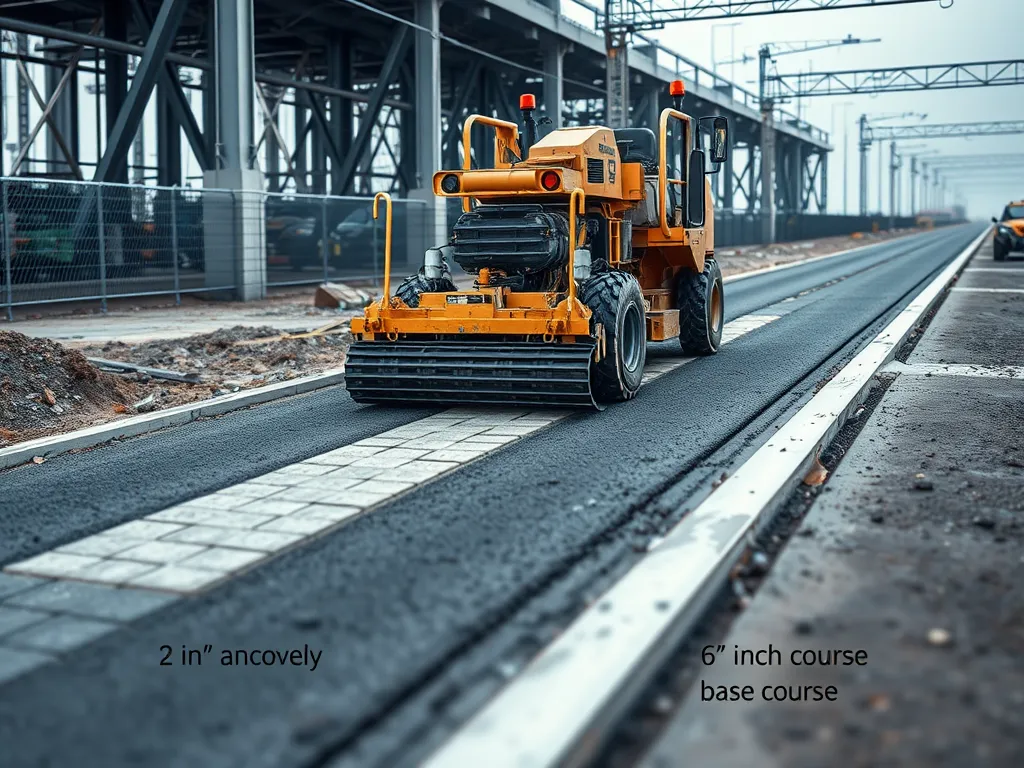
A 2-inch overlay vs a 6-inch base course changes the game. Fixed screeds handle 1-3” layers, while extendable hydraulic models tackle 4-12” depths. Match compaction force (8,000-12,000 N/m² for typical roads) to lift thickness. Thicker layers need pavers with high-frequency vibrators (50-70 Hz) and dual compaction systems.
With your job’s specs mapped, focus shifts to paver types and features that hit those targets. Let’s compare mechanical, sensor, tracked, and wheeled options.
Types Of Asphalt Paver Machines
Picking the right paver starts with knowing your options. Two primary distinctions shape paver machine selection: control systems (mechanical vs. sensor) and mobility (tracked vs. wheeled). Each variation impacts asphalt mat quality, job site adaptability, and long-term costs.
Mechanical Pavers Vs. Sensor Pavers
Mechanical pavers rely on manual input for screed height and slope adjustments. Operators control mat thickness via physical levers. Sensor pavers integrate automated systems with sonic or laser sensors that adjust screeds in real-time based on pre-set grades.
Key Differences in Operation
Mechanical units work best on flat, uniform surfaces with minimal grade changes. Sensor pavers tackle complex slopes (up to 8% grade) and irregular bases. A sensor paver’s GPS-linked controls can maintain ±3mm accuracy, vs. ±6mm with mechanical models.
Pros and Cons for Asphalt Applications
Mechanical pavers cost 15-20% less upfront ($180k-$250k vs. $220k-$320k for sensor models) but require skilled operators. Sensor pavers cut labor costs by 30% on highway jobs with tight specs. Hot mix asphalt (HMA) above 300°F performs optimally with sensor pavers due to consistent spread rates.
Tracked Vs. Wheeled Pavers
Tracked pavers distribute weight across 35-45 PSI, ideal for soft soils or fresh base layers. Wheeled models apply 60-80 PSI, suited for stable surfaces like milled asphalt or concrete. Tracked units move at 0-20 ft/min; wheeled reach 0-80 ft/min.
Surface Compatibility Considerations
Pick tracked pavers for gravel roads, parking lots with unbound bases, or jobs requiring frequent direction shifts. Wheeled pavers dominate highway work, offering faster travel between dump trucks. For patchwork on existing asphalt, wheeled models with 8’-12’ screeds minimize setup time.
Next, focus shifts to specs that directly impact mat quality – from width adjustments to thermal controls. Your paver’s technical capabilities must align with mix designs and compaction goals.
Also See: Bio-based Asphalt Innovations: Revolutionizing Roads
Key Features for Effective Asphalt Paving
Selecting the right paver machine hinges on specific features that directly influence project outcomes. Focus on three core elements: paving width flexibility, control systems, and material handling.
Paving Width Adjustability
Modern pavers offer widths from 8 to 16 feet. Adjustable screeds let crews tackle narrow driveways or multi-lane highways without equipment swaps. Look for models with hydraulic extensions for on-site tweaks.
Matching Width to Road/Lane Dimensions
Standard U.S. traffic lanes measure 12 feet. For highway work, pick pavers reaching 16 feet to cover full lanes in single passes. Subdivisions require 8–10-foot ranges. Mismatched widths cause overlaps or gaps, risking uneven compaction.
Control Systems and Precision
Sensor-guided systems outperform manual controls. GPS-enabled pavers reduce human error by 20–30% on complex slopes. Prioritize machines with real-time feedback loops for consistent mat thickness.
Grade/Slope Automation Capabilities
Slopes exceeding 2% demand automated grade control. Dual-axis sensors maintain crossfall and longitudinal tilt within 1/8-inch tolerances. This prevents water pooling on roads and ensures DOT compliance.
Material Feed and Temperature Management
Hot-mix cools 5°F per minute during paving. Auger systems with variable-speed drives distribute mix evenly before it drops below 275°F. Paired with heated screeds, these features prevent thermal segregation and costly rework.
With these features nailed down, the next step involves balancing performance against financial constraints.
Budget and Cost Analysis
Selecting paver machines requires balancing upfront costs with long-term value. Every dollar spent impacts project margins and equipment lifespan. Let’s break down financial factors for choosing the right paver.
New Vs. Used Asphalt Pavers
New pavers cost $150,000-$500,000+ but include warranties (3-5 years standard) and latest tech like GPS grade control. Used models start at $50,000 but may lack emission compliance (Tier 4 Final standards) or require $15,000-$40,000 in immediate repairs. Tracked pavers retain 65%-75% resale value after 5 years versus 50%-60% for wheeled models.
Long-Term Cost Implications
- Fuel efficiency: New Tier 4 engines use 12-15% less diesel hourly than pre-2015 models
- Downtime: Used pavers average 18% more unplanned maintenance days annually
- Lifespan: Properly maintained new pavers last 8,000-12,000 operating hours vs. 3,000-5,000 for refurbished units
Rental Vs. Purchase Options
Daily rentals ($800-$1,200) work for single projects under 30 days. Purchasing becomes cost-effective beyond 150 operating hours yearly. Contractors handling 10+ asphalt jobs annually typically save 22%-35% through ownership.
Break-Even Point Calculations
Use this formula to compare rental costs vs. purchase: (Machine Price ÷ Daily Rental Rate) = Break-Even DaysExample: A $250,000 paver rented at $1,000/day breaks even after 250 days. Factor in tax benefits like Section 179 deductions ($1,080,000 cap in 2023) and 5-year depreciation schedules.
Cost efficiency ties directly to environmental performance. Next, we’ll explore emission standards and fuel metrics for sustainable paver machine selection.
Environmental Considerations for Asphalt Equipment
Paver machine selection directly impacts environmental performance. Balancing productivity with eco-friendly practices requires evaluating emissions, fuel use, and sustainable technologies.
Emission Standards Compliance
Modern asphalt pavers must meet strict emission regulations. In the U.S., EPA Tier 4 Final standards limit particulate matter (PM) to 0.02 g/kWh and nitrogen oxides (NOx) to 0.26 g/kWh. European Stage V rules are even tighter, capping PM at 0.015 g/kWh. Verify machines have diesel particulate filters (DPF) or selective catalytic reduction (SCR) systems. Non-compliant units risk fines up to $37,500 per violation under the Clean Air Act.
| Standard | PM Limit | NOx Limit | Key Tech |
|---|---|---|---|
| EPA Tier 4 Final | 0.02 g/kWh | 0.26 g/kWh | SCR + DPF |
| EU Stage V | 0.015 g/kWh | 0.40 g/kWh | DOC + DPF |
Fuel Efficiency Metrics
Fuel costs account for 35-40% of paver running expenses. Compare models using gallons-per-hour (GPH) data under load. Tracked pavers average 2.5-3.8 GPH, while wheeled units use 1.8-2.5 GPH. Look for eco-modes that cut idle consumption by 22% and automatic engine shutdown after 5 minutes of inactivity.
Reducing Carbon Footprint in Paving Operations
Pair fuel-efficient pavers with reclaimed asphalt pavement (RAP) mixes containing 30-50% recycled material. Electric/hybrid pavers reduce jobsite emissions by up to 60% compared to diesel models. Telematics systems like Cat® Connect optimize material usage, trimming waste by 12-15% per project.
Next, we’ll address frequent questions about balancing specs with budget in paver machine selection.
Paver Machine Selection FAQs
How Do I Choose Between Mechanical and Sensor Pavers for Asphalt?
When deciding between mechanical and sensor pavers, consider the complexity of your project. Mechanical pavers are suitable for simpler tasks with less grade variation, while sensor pavers excel in projects requiring precision in slope and thickness. If your project involves intricate designs or variable surfaces, opt for a sensor paver to ensure consistent quality and efficiency.
What Specifications Matter Most for Asphalt Layer Quality?
For optimal asphalt layer quality, focus on specifications such as the accuracy of the control system, the temperature management capabilities of the screed, and the paver’s ability to adjust to varying widths and thicknesses. A paver with a robust control system that allows for real-time adjustments will help maintain a consistent mat thickness, which is critical to the longevity of the pavement.
Can One Paver Handle Multiple Asphalt Project Types?
While some pavers are versatile enough to handle different types of asphalt projects, it’s essential to consider the specific requirements of each job. Pavers equipped with adjustable features and advanced control systems can accommodate various thicknesses and mixes, making them suitable for multiple applications. However, highly specialized tasks may require dedicated equipment to achieve the best results.
Closing Thoughts
Selecting the right paver machine is vital for your asphalt project’s success. Consider factors like project size, material type, and specific features such as paving width adjustability and automation capabilities. Each element impacts not only the quality of the paving but also overall project efficiency and budget. Weigh your budget against long-term needs, exploring whether to purchase, rent, or seek used equipment.
With the right machine in your corner, you can ensure a smooth, durable asphalt surface. Make informed choices and enhance your paving operations by utilizing appropriate technology tailored to your unique project requirements.
For more detailed insights and tools on asphalt paving, visit Asphalt Calculator USA.
Additional Resources for You:
- Federal Highway Administration (FHWA) – Asphalt Pavement Technologies
- How To Choose An Asphalt Paver | Tracey Road Equipment
- How to Choose the Right Paver for Your Project Landscaping
- How to Choose the Right Paver for Your Project | Different Types of Pavers Explained
- The Ultimate Guide to Choosing the Right Backyard Pavers