How to Choose the Right Asphalt Paver for Your Project
Published on: January 23, 2026 | Last Updated: April 14, 2025
Written By: George Voss
Choosing the right asphalt paver requires matching machine specs to your project’s size, surface type, and asphalt mix. Factors like paver type (wheel, track, mini, or heavy-duty), operating costs ($75-$250/hour rental rates), and hopper capacity (4-15 tons) directly impact efficiency and budget. Compare manufacturer specs for screed heating, propulsion systems (wheel vs. track), and automation features to ensure precision in density (typically 92-96% compaction) and thickness (1.5-4 inches). Reviews of brands like Volvo, Caterpillar, and Dynapac help gauge reliability for roads, parking lots, or specialized jobs.
This guide breaks down six critical steps: assessing project scope, selecting paver types, evaluating key features, analyzing costs, sizing equipment, and reviewing maintenance needs. Learn how track pavers excel on uneven terrain, why heated screeds prevent mat cooling in cold weather, and when renting a mini paver saves up to $1,200/day versus buying. Get actionable tips to balance upfront costs with long-term value while meeting environmental and quality standards.
Contents
- Understanding Your Project Requirements
- Types Of Asphalt Pavers
- Key Features to Evaluate
- Cost Considerations
- Selecting the Right Size and Capacity
- Maintenance and Durability Factors
- Environmental Impact Considerations
- Additional Features and Accessories
- Frequently Asked Questions (FAQs)
- Final Recommendations and Summary
- Additional Resources for You:
Understanding Your Project Requirements
Start by analyzing your job’s basics. This groundwork impacts which paver fits your goals.
Assessing Project Size and Scope
Job size dictates paver class. Compact pavers handle driveways or patches (under 1,000 sq. yd). Mid-size units work for parking lots (5,000–10,000 sq. yd). High-output pavers with 300+ ton/hour capacity suit highways or airport runways. Track daily output targets – a 12-hour shift with a 10-ft-wide paver can lay ~1,800 tons.
Determining Optimal Paver Width and Depth
Paver width must align with surfacing needs. For roads, match lane width – 8–12 ft units for local streets, 15–20 ft for highways. Depth capacity matters for thick lifts: standard pavers handle 4–6 in layers, while modified units manage 10 in. A 2 in deviation from target thickness can add $1.50–$3.00 per sq. yd in material costs.
Evaluating Asphalt Specifications (Density, Thickness, and Mix Type)
Mix type affects paver settings. SMA (Stone Mastic Asphalt) needs dual tamping bars for 95%+ density. Polymer-modified mixes require heated screeds (250–300°F) to avoid tearing. Check if your paver’s vibration system matches target air voids – 3–5% for highways, 5–8% for driveways.
Identifying Surface Type (Roads, Parking Lots, or Specialized Applications)
Surface dictates paver features. Track pavers grip better on slopes (up to 8% grades) for roadwork. Wheel pavers maneuver tight radii in parking lots. For porous asphalt (20% voids), pick units with adjustable material feed gates. Specialty jobs like racetracks may need pavers with laser-guided slope control (±0.1 in accuracy).
With your project’s framework clear, comparing paver types becomes straightforward. Next, look at how wheel, track, and mini models stack up for your job.
Types Of Asphalt Pavers
Your asphalt paver selection directly impacts project efficiency and pavement quality. Let’s break down four primary types used in North America.
Wheel Pavers
Rubber-tired models with 8-16 ft screed widths dominate small-to-medium projects. Their 2-6 mph travel speed balances mobility and precision.
Features and Best Use Cases
Wheel pavers excel on flat surfaces like parking lots or residential streets. The rubber tires provide 85-90% surface contact, minimizing marks on fresh asphalt. Choose these for projects under 5,000 sq yd with PG 64-22 binder mixes.
Track Pavers
Steel-track models handle 10-20 ft widths and deliver 95%+ compaction. Their crawler undercarriage distributes 35-75 tons of machine weight evenly.
Features and Best Use Cases
Track pavers outperform on unstable bases or slopes exceeding 5%. Ideal for highway interchanges or Superpave mixes requiring 150°F+ laydown temps. Expect 15-25% higher production rates vs wheel models on large-scale jobs.
Mini Pavers
Compact units under 8 ft wide tackle tight spaces. Most have 0.5-2 yd³ hoppers and 1-3 mph pacing for detail work.
Features and Best Use Cases
Use mini pavers for bike lanes, utility cuts, or repairs needing 1-3” lifts. Their 180° pivoting screeds handle radius turns down to 6 ft. Popular for SMA mixes in urban areas with 300-800 sq yd daily output targets.
Heavy-duty Pavers
High-output machines with 16-50 ft extendable screeds dominate mega-projects. Dual tampers and 400+ hp engines handle 12”+ base layers.
Features and Best Use Cases
Reserved for airport runways or interstate highways requiring 500+ tons/hour placement. These giants maintain ±1/8” thickness tolerance on polymer-modified mixes. Require 40-60 ft material transfer vehicles for continuous operation.
With paver types clarified, let’s examine critical performance features that separate adequate equipment from exceptional paving partners.
Key Features to Evaluate
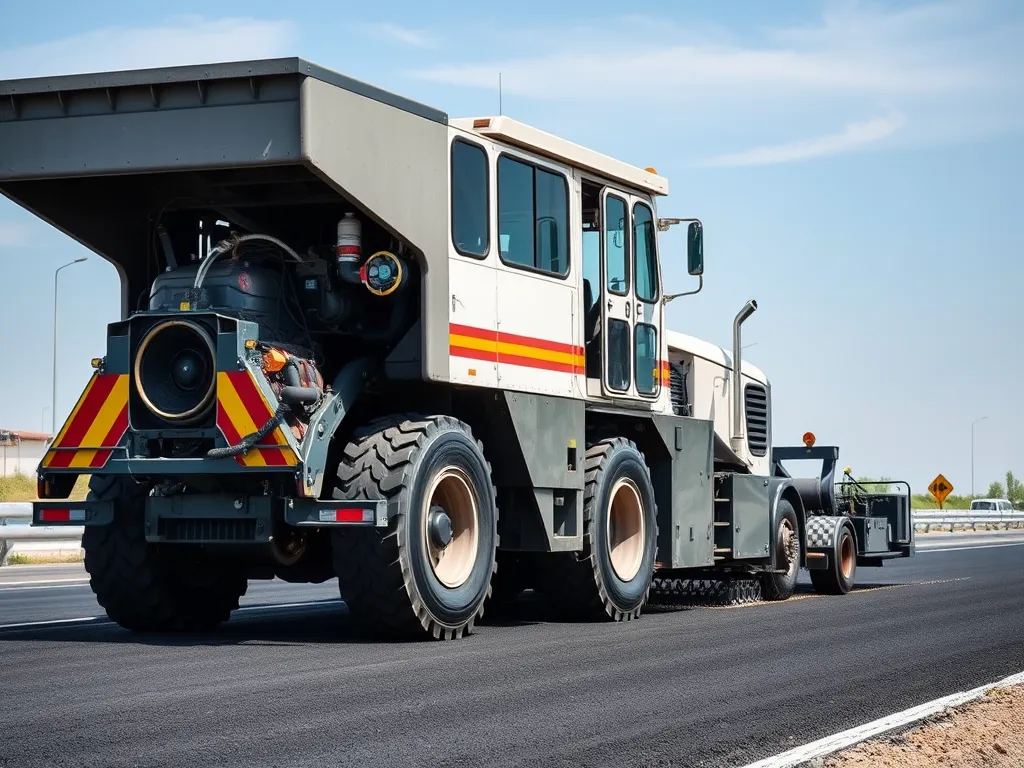
Choosing the right asphalt paver requires balancing technical specs with job demands. Focus on these four core systems to match equipment performance to your project’s needs.
Propulsion System (Wheel Vs. Track)
Wheel pavers (6-10 psi ground pressure) excel on stable surfaces like existing pavement. Track pavers (5-8 psi) dominate unstable terrain—think road bases or fresh gravel. Tracks offer better weight distribution, reducing ruts on soft subgrades. For tight spaces, wheel models maneuver faster. Match propulsion to surface stability: tracks for soft ground, wheels for paved areas.
Screed Type and Heating Options
Fixed-width screeds handle standard 10-12 ft lanes. Extendable screeds adjust from 8 ft to 50 ft for variable widths. Electric or propane heaters (250-300°F) prevent mix sticking in cold pours. Vibratory screeds boost density by 1-2% versus static models. For airport runways or highways, heated vibrating screeds ensure uniform compaction at 290°F.
Hopper Capacity and Material Flow Control
Hoppers range from 8-ton mini-paver units to 15-ton highway models. High-capacity hoppers (12+ tons) cut refill stops on large jobs. Auger-controlled flow systems distribute 200-400 tons/hour with ±5% precision. Look for adjustable slat feeders and auger speeds—critical for maintaining 145°F+ mix temps during placement.
Automation and Precision Controls
Grade/Slope systems like Leica iCON or Topcon Sonic Ski reduce manual adjustments by 30-50%. GPS-enabled pavers achieve ±0.1-inch elevation accuracy. Telematics track fuel use (3-8 gallons/hour) and mat temps in real time. Automated screed controls maintain target thickness within 1/8-inch tolerances—key for SMA or Superpave mixes.
These features directly shape productivity and pavement quality. Next, we’ll break down how they impact your budget in the Cost Considerations section.
Also See: Asphalt Lifespan Expectations for Highways
Cost Considerations
Budget decisions directly impact paver selection. Balance short-term spending with long-term returns using these key factors.
Rent Vs. Buy Analysis
Renting suits projects under 30 days or needing specialized units like mini pavers. Daily rates range $400-$1,200. Buying makes sense for yearly use exceeding 60 days. New pavers cost $150k-$500k, while used models start at $80k. Example: A 10-day rental ($8k) vs. buying used ($90k) breaks even after 11 projects.
Fuel Efficiency and Operating Costs
Track pavers use 2-4 gallons/hour, wheel models 1.5-3 gallons/hour. Diesel engines in heavy-duty pavers like Caterpillar AP655F cut consumption by 12% versus older designs. Hybrid-electric options trim yearly fuel bills by $3k-$7k. Factor in lubricant costs ($0.25-$0.50 per ton laid) and emission compliance fees.
Labor Cost Reduction Through Multi-functional Designs
Pavers with dual screed heating (electric + propane) or automated grade control slash crew needs. A Volvo ABG6880 with integrated sensors lets one operator handle tasks previously needing three workers. Multi-functional units lower labor by 20-35% on projects over 5,000 tons.
Long-term Value Vs. Upfront Investment
High-end pavers like Dynapac SD2500CS cost 15-20% more upfront but last 12-18 years versus 8-10 for budget models. Calculate cost per ton: $200k paver laying 50k tons yearly = $4/ton over 10 years. Cheaper $150k units needing frequent repairs might hit $6/ton. Check warranty terms—look for 5+ years on screeds and 3+ on engines.
With budget factors mapped, the next step involves matching machine specs to your project’s physical demands.
Selecting the Right Size and Capacity
Picking the correct paver size directly impacts project speed, material efficiency, and finish quality. Over- or under-sizing leads to wasted resources or uneven paving. Let’s break down key factors for matching equipment to jobs.
Standard Paver Widths for Common Projects
Paver widths range from 8-foot mini models to 25-foot highway machines. Residential driveways (8-12 feet) pair with compact pavers like the Roadtec RP3. Commercial parking lots (12-16 feet) often use Blaw-Knox PF-161 or Volvo ABG models. Highway projects (16-25 feet) demand heavy-duty options like Caterpillar AP655F with extendable screeds. Always add 1-2 feet to the target mat width to ensure full coverage during adjustments.
Matching Depth Capabilities to Asphalt Specifications
Depth settings affect compaction and layer durability. Standard pavers handle 0.5-6 inch lifts. For 2-inch driveway layers, basic fixed screeds work. Thicker highway courses (4-6 inches) need heated vibratory screeds to maintain 290°F+ mix temps. Check if your asphalt mix (HMA, SMA, or warm-mix) requires specific density profiles. Track pavers like Dynapac SD2500WS excel at consistent depth control on slopes above 5%.
Capacity Requirements for Large-scale Vs. Small-scale Projects
Hopper capacity dictates how much asphalt gets laid per load. Mini pavers (6-8 ton hoppers) suit patch jobs under 500 sq.yd. Large road projects demand 15+ ton hoppers paired with material transfer vehicles (MTVs) to maintain 150-200 tons/hour flow rates. For 10-mile highway jobs, choose pavers with 400+ gallon fuel tanks to reduce refill stops. Budget 1 paver per 3,000 sq.yd/hour output to meet typical DOT timelines.
With size and capacity dialed in, the next step is ensuring your paver withstands daily wear. Maintenance practices make or break equipment lifespan – let’s explore critical upkeep strategies.
Maintenance and Durability Factors
Long-term performance of your asphalt paver depends on maintenance habits and build quality. The right choice balances upfront costs with repair frequency and component longevity.
Routine Maintenance Requirements
Daily greasing of augers, screed plates, and conveyors prevents material buildup. Track pavers need undercarriage cleaning every 8-10 hours to avoid debris damage. Wheel models require tire pressure checks (35-45 psi) and alignment adjustments. Budget 2-3 hours weekly for tasks like hydraulic filter replacements (every 500 operating hours) and infrared temperature sensor calibration.
Key Components Affecting Lifespan
High-grade steel screeds last 7-10 years versus 3-5 for standard models. Tier 4 Final diesel engines reduce rebuild needs by 30% compared to older Tier 3 systems. Opt for pavers with dual-circuit hydraulic pumps – they maintain 95% efficiency after 8,000 hours versus 70% in single-pump designs. Belts with Kevlar reinforcement withstand 40% more abrasion than rubber-only versions.
| Component | Premium Version Lifespan | Standard Version Lifespan |
|---|---|---|
| Screed Plates | 12,000-15,000 tons | 6,000-8,000 tons |
| Conveyor Belts | 5-7 years | 2-4 years |
| Hydraulic System | 10,000+ hours | 6,000-8,000 hours |
Seasonal Maintenance Best Practices
Winterize fuel systems with antigel additives below 40°F. Summer projects demand daily coolant level checks (50/50 ethylene glycol mix) to prevent overheating. Store pavers on gravel pads during rainy seasons – concrete slabs accelerate undercarriage rust by 22%. Apply silicone-based lubricants to electrical connectors in humid climates to stop corrosion.
Smart asphalt paver selection requires weighing these factors against project timelines and budgets. Up next: how your equipment choices affect environmental compliance and site emissions.
Environmental Impact Considerations
Every paving decision carries environmental consequences. Engine choices and operational practices directly affect air quality, fuel use, and long-term sustainability. Let’s break down critical factors influencing eco-friendly asphalt paver selection.
Gas Vs. Diesel Engine Emissions
Diesel engines power 82% of commercial pavers but emit higher nitrogen oxides (NOx) and particulate matter. Gas models cut NOx by 30-40% while reducing carbon monoxide output. New EPA Tier 4-compliant diesel systems lower sulfur emissions by 99% compared to older models. Consider this trade-off:
| Metric | Diesel Paver | Gas Paver |
|---|---|---|
| CO2 per hour | 12-18 lbs | 8-14 lbs |
| Fuel Efficiency | 5.2 gal/hr | 6.1 gal/hr |
| Best For | Heavy-duty, long shifts | Residential/small projects |
Strategies for Reducing Carbon Footprint
Modern pavers integrate three eco-innovations: electric drive systems, biofuel compatibility, and idle-reduction tech. Volvo’s EC550E cuts fuel use 15% with hybrid tracks. Pair these with recycled asphalt pavement (RAP) mixes – using 30% RAP slashes emissions by 12 tons per mile laid. Thermal screed systems also trim energy waste, maintaining mix temps with 20% less fuel burn.
New infrared heaters prevent mix cooling during placement – a key factor in 18% of project delays. Telematics systems like Cat’s LINK™ track real-time emissions, helping crews adjust workflows. For urban zones, look for pavers meeting CARB 2024 standards with particulate filters.
Up next: Smart features that boost both environmental performance and paving precision. The right attachments can transform your paver into a multi-tasking sustainability tool.
Additional Features and Accessories
Modern asphalt pavers go beyond basic laydown functions. Smart add-ons boost capability, cut labor hours, and adapt to shifting job demands. Prioritize units with modular designs that grow with your workload.
Upgrade Options for Future Needs
Look for pavers with bolt-on tech like screed extensions (adding 2-6 ft width) or dual-material hoppers. GPS grade control systems (±3mm accuracy) future-proof your kit for high-precision jobs. Tier 4 Final diesel engines slash particulate output by 90% vs older models – vital for urban zones tightening air rules. Upfront costs run 15-30% higher but avoid full machine replacements later.
Essential Attachments for Specialized Tasks
Match add-ons to project specs: – Material transfer vehicles (MTVs) maintain 290°F mix temps during long hauls – Infrared heating units revive cold spots in existing pavement – Slope sensors auto-adjust screeds for 0.1% grade accuracy on complex terrain Renting niche tools like joint matchers ($450/day) often beats buying for one-off jobs. Attachments trim manual labor by 20% on average in paving cost studies.
With the right upgrades and attachments in place, operators often ask how to keep their pavers running strong for decades. Next, we’ll break down maintenance musts that protect your investment.
Frequently Asked Questions (FAQs)
How Do I Choose the Right Pavers for My Project?
Choosing the right paver depends on your project’s size, surface type, and asphalt mix specifications. Ensure the paver type matches the job requirements, including width and depth capabilities, to optimize performance and efficiency.
How Can You Tell the Quality Of Asphalt?
The quality of asphalt can be assessed by checking its density, composition, and the type of aggregates used. Conducting a series of tests, such as the Marshall or Superpave methods, can help ascertain the asphalt’s performance characteristics.
What is the Standard Width Of Asphalt Pavers?
Standard asphalt paver widths typically range from 8 feet for mini pavers to 25 feet for heavy-duty models. The selection of width should align with the project’s requirements, taking into account the type of surface being paved.
What is Cheaper: Asphalt or Pavers?
The cost-effectiveness between asphalt and pavers can vary based on project scope, desired aesthetic, and maintenance factors. Generally, asphalt is lower in initial material costs, while pavers can provide better durability and aesthetics over time.
What Maintenance Should I Perform on My Asphalt Paver?
Routine maintenance should include daily greasing, regular checks of the hydraulic system, and cleaning of the undercarriage. Scheduling periodic inspections and replacing wear parts can significantly extend the life of the paver.
What Features Should I Consider for Automation in Asphalt Pavers?
Features such as grade and slope control systems, GPS technology, and telematics for real-time monitoring can greatly enhance automation in asphalt pavers. These technologies help improve precision and reduce reliance on manual adjustments.
Final Recommendations and Summary
Choosing the right asphalt paver can significantly impact the efficiency and quality of your project. Start by assessing your project requirements, including size, scope, and asphalt specifications. Knowing whether you need a wheel, track, mini, or heavy-duty paver is essential for matching the right machinery to your tasks.
Evaluate key features such as the propulsion system, screed type, and hopper capacity. Consider both short-term and long-term costs, weighing options between renting and buying. Keep maintenance in mind to ensure durability, as regular upkeep can extend the lifespan of your paver.
Environmental factors are increasingly important. Understand engine emissions and explore strategies to lower your carbon footprint. Remember to consider additional features and upgrade options for future needs.
For more information on asphalt pavers and to access tools like calculators and guides, visit Asphalt Calculator USA. Make an informed decision that meets your project’s requirements.