How Hot Does Asphalt Get on a 100-degree Day?
Published on: January 7, 2026 | Last Updated: April 14, 2025
Written By: George Voss
On a 100°F day, asphalt pavement reaches 140-160°F – 40-60 degrees hotter than the air temperature. This extreme heat can burn pet paws in under 60 seconds, with third-degree burns possible at 150°F. Dark asphalt absorbs 80-95% of solar radiation compared to lighter surfaces, creating dangerous conditions even during short walks.
This article breaks down the relationship between air temperature and asphalt heating. We explore why pavement temperatures spike, how material composition affects heat retention, and proven methods to test surface safety. You’ll get specific data on burn risks for dogs, temperature measurement techniques using infrared thermometers (average cost: $25-$150), and strategies to reduce urban heat island effects from paved surfaces.
Contents
- Understanding Asphalt Temperature Vs. Air Temperature
- Asphalt Temperature at 100 Degrees Fahrenheit
- Factors Influencing Asphalt Temperature
- Safety Risks Of Hot Asphalt
- Measuring and Testing Asphalt Surface Heat
- Mitigating Hot Asphalt Effects
- Environmental Considerations
- Frequently Asked Questions
- Closing Thoughts
- Additional Resources for You:
Understanding Asphalt Temperature Vs. Air Temperature
Asphalt surfaces act as solar sponges, absorbing up to 95% of sunlight energy compared to air’s minimal heat retention. This explains why the asphalt temperature on a 100-degree day climbs far beyond weather forecasts. While air cools rapidly through convection, pavement traps thermal energy in its dense structure.
Why Asphalt Absorbs More Heat Than Air
Three factors drive asphalt’s heat absorption: color, material density, and thermal emissivity. Jet-black bitumen (the binding agent in asphalt) absorbs 87-95% of solar radiation. Combined with stone aggregates, this creates a heat-retentive surface. Unlike air molecules that dissipate heat quickly, asphalt releases absorbed energy slowly – often over 6-8 hours after sunset.
Typical Temperature Differential Between Asphalt and Air
On a 100°F day, asphalt reaches 125-140°F in direct sunlight. Data from the National Center for Asphalt Technology shows a consistent 25-50°F difference between air and pavement temperatures. At peak solar intensity (1-3 PM), surfaces often hit 135°F – hot enough to fry an egg in 5 minutes. Shaded asphalt stays cooler, averaging 15-20°F above ambient air.
Concrete comparison: At 100°F air temp, concrete averages 125°F vs asphalt’s 140°F. The 15°F gap stems from asphalt’s lower albedo (reflectivity) rating of 0.05-0.10 versus concrete’s 0.35-0.40.
These temperature spikes depend on multiple variables – let’s examine what amplifies asphalt heat retention.
Asphalt Temperature at 100 Degrees Fahrenheit
On days with triple-digit heat, asphalt transforms into a heat trap. Let’s break down the science behind surface temps and risks.
How Hot Does Asphalt Get on a 100-degree Day?
Asphalt hits 140-160°F on a 100°F day. The dark surface absorbs 80-95% of solar radiation, creating a thermal mass effect. At 125°F, burns can occur in seconds. By 140°F, pavement becomes hazardous for skin contact. Peak temps typically strike between 1-3 PM in full sun.
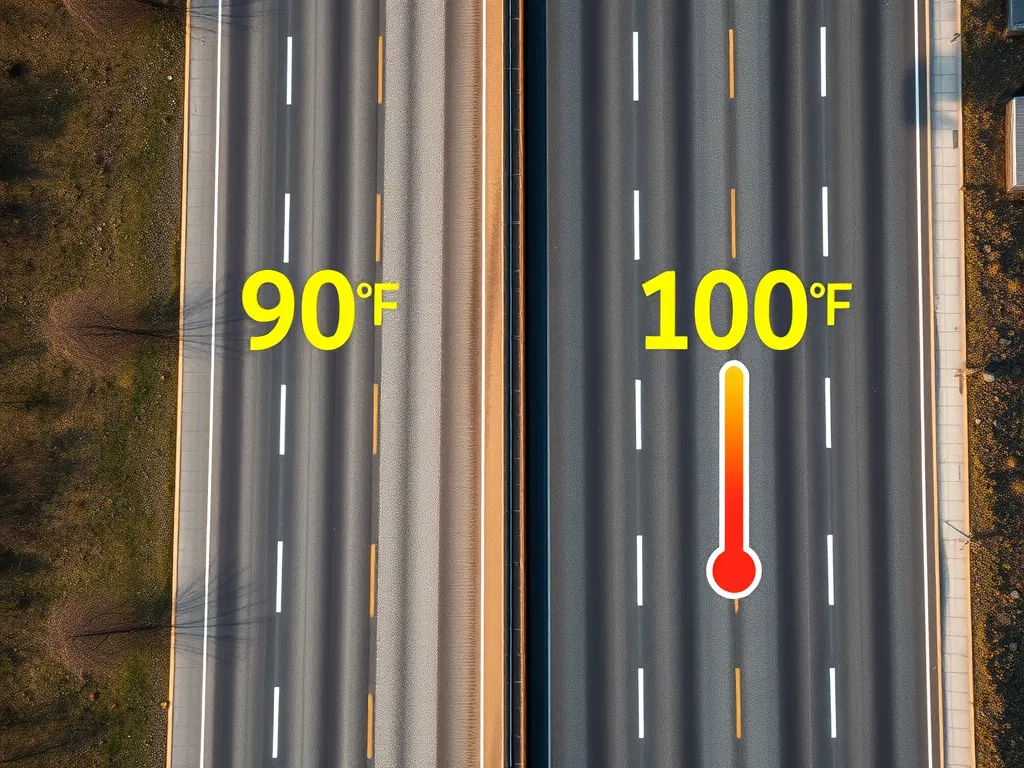
Comparing 90°F Vs. 100°F Days: Asphalt Temperature Differences
A 10°F air temp jump creates a 15-20°F asphalt spike. At 90°F air, pavement averages 130-145°F. At 100°F, it climbs to 140-160°F. This 10-15°F gap impacts pet safety and material durability. For every 1°F air temp rise, asphalt gains 1.5-2°F in direct sunlight.
Material composition and sun exposure play key roles in these variations. Let’s explore how ingredients and environment shape pavement heat next.
Factors Influencing Asphalt Temperature
Asphalt temperature at 100°F air heat depends on two primary variables: its physical makeup and environmental exposure. These elements dictate why surfaces can reach 150°F+ in summer.
Material Composition and Heat Retention
Asphalt mixes contain aggregates (crushed stone, sand) bound by bitumen. Bitumen, a petroleum-based binder, has high thermal mass—it absorbs 2x more heat than concrete per square foot. Dense-graded Superpave mixes with 5-7% bitumen content typically reach 125-140°F in 100°F weather. Polymer-modified PG 76-22 binders, used in high-traffic areas, boost heat retention by 8-12°F compared to standard mixes.
Impact Of Direct Sunlight Exposure
Solar radiation amplifies asphalt temperature on 100-degree days. Dark surfaces absorb 90-95% of UV rays versus 35% for light-colored materials. At peak solar noon, unshaded asphalt gains 1°F every 5 minutes until reaching equilibrium. Cloud cover reduces temps by 15-20°F, while shaded areas stay 30°F cooler. Thermal emittance rates—how quickly surfaces release heat—also play a role. Asphalt radiates 40% less heat than concrete, leading to prolonged high temps after sunset.
These material and environmental factors combine to create surfaces that require careful monitoring during heat waves. Next, we’ll examine safety thresholds for pets and humans interacting with hot pavement.
Also See: How to Properly Dispose Of Hot Asphalt Responsibly
Safety Risks Of Hot Asphalt
Asphalt temperature on a 100-degree day poses hidden dangers beyond human discomfort. Surfaces can exceed 140°F within minutes of direct sun exposure, creating burn risks for unprotected skin and paws.
When is Asphalt Too Hot for Pets? (temperature Thresholds)
Veterinary studies show asphalt becomes unsafe for pets at 125°F. On a 100°F day, pavement temperatures reach 140-160°F within 30 minutes – far above the danger threshold. Follow the 5-second rule: Place your hand on the surface. If you can’t hold it for five seconds, your dog shouldn’t walk on it.
Identifying Burn Risks for Dog Paws
Dog paw pads burn at 130°F, equivalent to asphalt temperatures during 85°F+ weather. At 100°F air temps, watch for these signs:
- Limping or refusal to walk
- Darkened or blistered paw pads
- Excessive licking of feet
A 2016 Journal of Veterinary Medical Science study found 77% of thermal paw injuries occur on surfaces exceeding 125°F. Brachycephalic breeds (pugs, bulldogs) and senior dogs face higher risks due to slower reaction times.
Monitoring asphalt temperature in 100-degree weather requires more than weather apps. Let’s examine reliable measurement tools to prevent heat-related injuries.

Measuring and Testing Asphalt Surface Heat
Accurate heat measurement prevents burns and guides safety decisions during extreme weather. On days when air temps reach 100°F, asphalt surfaces can spike 60-70°F higher than ambient conditions. Reliable testing methods matter for pet owners, parents, and construction crews.
Practical Methods to Check Asphalt Temperature
Three tools dominate asphalt temp checks on scorching days. IR thermometers (non-contact devices) capture surface heat from 6-12 inches away. The 5-second hand test involves pressing the back of your palm to the pavement—discomfort means unsafe temps. Contact probes clamp onto surfaces but require direct exposure to heated zones. For quick checks, smartphone apps paired with Bluetooth sensors offer real-time data without physical contact.
Infrared Thermometers Vs. Hand Tests
IR thermometers deliver precision: on a 100°F day, they’ll show asphalt temps between 145-160°F within ±2°F accuracy. Hand tests rely on pain response—125°F causes discomfort at 5 seconds, while 140°F+ burns skin in seconds. Though accessible, hand tests risk false readings due to calloused skin or rapid heat adaptation. For pet paws, always opt for IR devices; dogs feel burns at temps 30°F lower than human thresholds.
Accurate temp tracking sets the stage for effective heat management. Next, let’s explore ways to cool surfaces and protect vulnerable users.
Mitigating Hot Asphalt Effects
Hot asphalt poses risks to infrastructure and living things, but smart tactics can cut its impact. Proactive cooling and safety protocols limit harm from surfaces hitting 135-155°F in 100°F conditions.
Cooling Techniques for Driveways and Parking Lots
Light-color sealcoating slashes surface temps by 20-30% by boosting solar reflection. Hydro-cooling with misting systems drops temps up to 15°F instantly. Permeable asphalt mixes allow water drainage, cutting thermal buildup through evaporation. For critical zones, install shade sails blocking 90% of UV rays.
Protective Measures for Pets and Pedestrians
Walk dogs before 10 AM or after 6 PM when asphalt cools below 125°F. Test surfaces with a hand: If too hot for 5 seconds, it risks paw burns. Install rubberized walkway mats with 40-60% albedo ratings. Foot traffic zones gain relief from spray-on ceramic coatings that cut radiant heat by 35%.
While cooling tactics aid short-term relief, long-term solutions target asphalt’s role in warming local climates. Upcoming strategies focus on…

Environmental Considerations
Asphalt’s heat absorption affects more than surface temps—it shapes entire ecosystems. Cities face amplified challenges due to vast paved areas acting as thermal batteries.
Urban Heat Island Effect From Asphalt Surfaces
Dark asphalt surfaces store solar energy, releasing it slowly after sunset. This process elevates ambient temps by 5-9°F in urban zones compared to rural areas. At 100°F air temps, asphalt can push city thermometers to 110°F+ by 7 PM. Materials like concrete (SRI 29-35) underperform vs. asphalt (SRI 0-12) in reflecting sunlight, worsening heat retention.
Reflective Coatings and Heat Reduction Strategies
Cool pavement technologies slash surface temps by 10-20°F. Key methods:
- High-albedo sealcoats (e.g., CoolSeal®): Reflect 30-50% sunlight vs. 5% for standard asphalt
- Permeable pavers: Allow water evaporation, dropping temps 12°F below traditional asphalt
- Rubberized asphalt: Recycled tire additives reduce heat retention by 15%
Phoenix’s 2023 cool roads pilot cut peak surface temps from 160°F to 132°F using reflective treatments—a 28°F drop for $3.50/sq yd.
Managing asphalt heat goes beyond comfort—it’s about creating safer spaces. Next, we’ll explore practical ways to test surface temps before stepping outside.
Frequently Asked Questions
How Hot is the Pavement When It’s 100 Degrees Outside?
On a 100°F outside day, pavement temperatures can reach between 140°F to 160°F, significantly hotter than the air temperature. This extreme heat can pose risks, especially for pets and humans alike.
Does Asphalt Get Hotter Than Air Temperature?
Yes, asphalt typically gets hotter than the surrounding air temperature. On a hot day, asphalt can be 40°F to 60°F warmer than the air, due to its ability to absorb and retain heat.
How Hot is Asphalt on a 90-degree Day?
On a 90°F day, asphalt generally reaches temperatures between 130°F to 145°F, demonstrating a significant temperature increase compared to the air temperature.
What’s the Asphalt Temperature at 100 Degrees in Celsius?
The asphalt temperature can reach approximately 60°C (140°F) to 71°C (160°F) on a 100°F day. This high temperature is dangerous and can cause burns quickly.
Can Asphalt Reach 150°F in Direct Sunlight?
Yes, asphalt can reach temperatures of 150°F or more in direct sunlight, especially during peak hours of heat. This level of heat can cause severe burns in a short time, making it hazardous for both humans and animals.
Closing Thoughts
Asphalt temperatures can soar significantly above the air temperature, especially on a sweltering 100-degree day. The heat retention of asphalt varies based on multiple factors, including material composition and sunlight exposure. It’s crucial to recognize not just how hot asphalt can get, but also the safety measures necessary for pets and pedestrians to avoid burns.
When planning outdoor activities or construction projects, consider the asphalt’s heat to ensure safety and comfort. Measuring surface temperatures and implementing cooling techniques can help mitigate the effects of intense heat.
For more information and resources about asphalt temperatures, along with helpful tools like our asphalt calculator, check out Asphalt Calculator USA.